- “Place the family at the centre of faith formation.”
- “A fundamental review of catechetical provision, sacramental preparation, and the Sacrament of Confirmation.”
 Taken together, these two proposals – from two different synodal working groups in 2026 – suggest a remarkable synergy and timeliness – with strategic implications for Irish Catholic education overall.
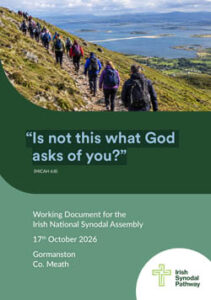
They can be found in appendices to the working document for Ireland’s Synodal Assembly, to take place in Gormanston, Co Meath on Saturday Oct 17th, 2026 – in the reports of working groups on Family and Faith Formation / Catechetics respectively.
Only a reworded version of the second of these proposals made it onto the final working document for the Synodal Assembly. This will probably be explained in terms of practicality. Even so, the fact that we can find both of these proposals highlighted in the appended 2026 working group reports tells us that a direction of travel is emerging that will end Irish Catholicism’s over-reliance upon school-centred faith formation and the fatal clerical malady it enabled: the disastrous shirking of direct and honest conversation with Ireland’s lay Catholic adults – especially those with care of children.
Synodal Assembly – Gormanston – 17th October 2026
That trajectory is supported in any case by other proposals that have made it into the working document – entitled “Is this Not What God Asks of You?”
- “This Assembly recommends that dioceses establish a family ministry team at pastoral area level.”
- “This Assembly recommends that the relevant agencies of the Irish Episcopal Conference develop a strategy for the provision of home-based faith tools.”
- “This Assembly recommends the appointment of dedicated catechists at diocesan and local faith-community levels, with a specific remit for accompaniment.”
- “This Assembly recommends that parishes and local faith communities are reclaimed as spaces where faith formation is central, holistic, lifelong, relational, and co-responsible.”
Are Ireland’s Catholic families now ready to do this ‘reclaiming’? Even the word ‘catechesis’ is a barrier to many – and a ‘fundamental review’ needs to address this by making it, for the first time in living memory, family friendly.
A very significant obstacle needs to be addressed. This is the tendency to speak and write of ‘faith formation’ as though we all have a clear and agreed ‘fix’ on what that word ‘faith’ most vitally refers to when – very obviously – we do not.
The Church that Proclaims the Gospel?
‘The Church that Proclaims the Gospel’ – this is to be ‘Pathway 1’ of Ireland’s overall ‘Synodal Pathway’ – and yet this working document is itself lacking a succinct proclamation of Christian faith – even though in 2019 Pope Francis gave us a striking example – aimed directly at young people.
“Christ is alive! He is our hope, and in a wonderful way he brings youth to our world, and everything he touches becomes young, new, full of life. The very first words, then, that I would like to say to every young Christian are these: Christ is alive and he wants you to be alive!” (Pope Francis, Christus Vincit, 2019)”
That emphasis on Jesus as a life-giving presence here and now – for everyone – has been sadly lacking up to now in Catholic Ireland’s proclamation of the Gospel. Instead we have tended to emphasise only the possibility of happiness after death, in Heaven.
Also our over-wordy Catechisms are compromised by passages on God the Father that fail to exonerate him emphatically from the suspicion of violence – of willing the cruelty of the Crucifixion to make satisfaction for sin. That the non-violence of Jesus is the non-violence of the Father was emphatically affirmed in the Urbi et Orbi address of Pope Leo at Easter 2026. This emphasis needs to be dominant in our catechesis – to restore the full import of the Lord’s prayer as our own statement of commitment to the building of the Kingdom of God.
The Family and the Kingdom
Where does God’s kingdom most obviously come if not in family life – in the sacrifices that adults – mothers especially – freely make in the cause of the happiness of children, and in the sacrifices those same children then make for one another? This spirit of sacrifice is also evoked in the call to youth ministry, and in the call to paths of discipleship for those same young people.
That Christian faith proclaims the presence of God among and within all of us now – and not just the possibility of life after death – needs to become the bedrock of our understanding of the Kingdom of God.
- “This Assembly recommends that the Irish Episcopal Conference develop a national digital evangelisation strategy with a youth focus to strengthen and coordinate the Church’s presence in digital spaces.”
Nothing could be more pressingly needed – and young people, properly equipped, will not simply be passive recipients of evangelisation. Too often a war zone – or a sleaze zone – the Internet is especially in need of an understanding of the Kingdom of God, and the young are especially suited to the task of humanising and pacifying it.
This Kingdom will also foster healing of all who have suffered abuse – and the co-responsibility of clergy and people. That both of these goals require change at the summit of the church, in structures and canons – to support commitment at ground level – needs to be part of what Irish bishops feed back to the international synodal events of 2027 and 2028 – to accompany this welcome evidence that Christ is alive in our synodal communion in Ireland here and now.
The equality of women in the Kingdom of God is still contradicted by the reservation to men only of ordination to the priesthood and diaconate, and the working group on Women is right to urge that this issue should remain part of ongoing discernment.
To the members of all seven working groups who worked so hard to a very tight deadline we owe our warmest thanks.
(As usual this feature article expresses a personal point of view and should not be interpreted as an official statement by ACI on everything it avers.)
~
Appendices to Working Document – Reports from Seven Working Groups
Belonging
Co-Responsibility – Lay Ministry
Faith Formation – Catechesis
Family
Healing
Women
Youth
Sean O’Conaill
September 24, 2026
0 Comments