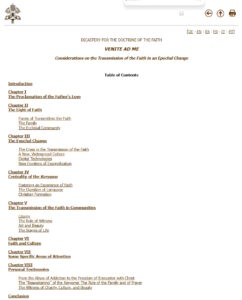
 An era of ‘epochal change’ in Western Countries – including Ireland – has created ‘a crisis in the intergenerational transmission of the Christian faith’, according to a document from the Vatican’s top body for monitoring the dissemination of Catholic faith.
‘Venite ad me‘ – a document of 144 dense paragraphs – pulls no punches in describing this situation:
” ...it is a fact that the large number of children and adolescents who drift away from the Church and the sacraments immediately after completing their Christian initiation or their course of formation in a Catholic school indicates that catechesis still struggles to find the most appropriate ways to foster a solid and lasting personal encounter with Christ.”
[Venite ad me § 79]
The document offers no easy solutions but points repeatedly to evidence that it is through close human relationships – and especially within families – that faith can cross the generation gap.
It also repeatedly urges adoption of different ways of proclaiming the ‘Good News’ of God’s kindly presence, through Jesus:
“It is precisely by proclaiming the kerygma in a way that is both renewed and renewing—passionate and capable of inspiring passion—that the community of believers will be able to fulfil the task of passing on, from generation to generation, the light that Jesus came to bring to the earth.”
[Venite ad me § 85].
The document arrives at a time when Irish Bishops have stated an intention to promote the role of parish Catechists, with a pilot programme to begin in some dioceses in September 2027. It will undoubtedly be studied closely in preparation for that.
The document is signed by Cardinal Victor Manuel Fernández, Prefect of the Vatican Dicastery for the Doctrine of the Faith.
For the complete document Venite ad me – click here.
The Church has been losing ground for at least the past three centuries because it did not engage with the amazing new story of our world and universe that human knowledge – science – was steadily revealing. It stayed in its spiritual ivory tower. This has now reached a tipping point, threatening the very future of the Church, at least in Europe.
The Church needs to listen and move in the direction of its foremost scientist-theologians – a rare breed – beginning with Pierre Teilhard de Chardin, Ilia Delio, Diarmuid O’Murchu, John Haught and others.
Finding and developing a personal relationship with Jesus is the heart of the Christian faith indeed, – but can the Church explain more inspiringly who this Christ is and what his role in the universe story might be? We cannot do without the intellectual dimension. The Church must learn to look outwards and finally embrace the world as God’s creation and give Christ his cosmic robes. When evolution finds its God, faith will take off at supersonic speed. Young people need a faith that relates to the real world as they know it.
The fixation with sexuality as the primary moral problem has surely also played a part in building this catechetical crisis Hilda? When you ask ‘who is this Christ?’ mustn’t the answer have more to do with his conquering of egotism than with his celibacy? To put up with every indignity – even the very worst – for our sake was surely a far greater moral achievement than simply not marrying? Only Richard Rohr has pointed to this moral achievement – the conquering of the impulse towards violence – and everyone knows how non-critical the church has been for many centuries of the violent ambitions of the statesmen who looked to the church to support them.
It’s surely too our ego that wants whatever others have that seems to give them greater social clout – luxuries of all kinds as well as ‘looks’?
You are surely right to critique the church’s failure to keep up with the science of evolution and of the universe, but human psychology is an advancing science too – a science that now values what it calls ‘spiritual intelligence’. Jesus obviously had that to an exceptional degree, but still today the crucifixion is more often explained in terms of obedience to God’s will than as rejection of violence. So if ‘God’s will’ for Jesus to die did not have to do with the overcoming of violence, what was its purpose? The suspicion that it had to do with the repayment of a debt caused by sin necessarily compromises God the Father in the violence of the crucifixion, instead of exonerating him. This ‘theology of suspicion’ in relation to the crucifixion is definitely another hindrance to catechetics today?