 Why does a standard Catholic catechetics resource for young people – published in 2011 – ask them to believe that the death of Jesus occurred only because God willed it? And fail to inform them of the capital sins that underlie all violence, including the crucifixion of Jesus?
This article by Sean O’Conaill appeared first in The Furrow in April 2026.
~
Q98 Did God will the death of his only Son?
A. The violent death of Jesus did not come about through tragic external circumstances. Jesus was “delivered up according to the definite plan and foreknowledge of God” (Acts 2:23). So that we children of sin and death might have life, the Father in heaven “made him to be sin who knew no sin” (2 Cor 5:21). The magnitude of the sacrifice that God the Father asked of his Son, corresponded to the magnitude of Christ’s obedience: “And what shall I say? ‘Father, save me from this hour’? No, for this purpose I have come to this hour” (Jn 12:27). On both sides, God’s love for men proved itself to the very end on the Cross.
[The Youth Catechism of the Catholic Church, 2011 – Article 98, Page 65]
Why should anyone be asked to believe that if God did will the death of his son for the reasons given, this death was not caused first of all by ‘tragic external circumstances’ – the sinful designs of men – that were never willed by God?
Does it not matter that through an obvious logical non sequitur a standard Catholic catechetical source for young people could lead them to attribute the violence of the crucifixion to the will of God, rather than to human hatred?
Is it unimportant also that YouCat does not explain at this point that God’s primary project was, and still is, the utterly non-violent Kingdom of God?
As, according to the Gospel, it was the rejection of the Kingdom offered by Jesus that led to his crucifixion, why does YouCat background that rejection as a mere ‘tragic external circumstance’ and foreground the Father’s will that Jesus should die?
How can that decision help young people today to understand the prayer that Jesus gave us, for what the Father wills first of all – the coming of the Kingdom of God?
For me, in failing to insist that the killing of any person – Jesus included – is never desired, intended or arranged by God, this Catechetical approach goes to the heart of a problem well stated by Archbishop Eamon Martin in Kilkenny on October 18th, 2025. “People need the faith, they need the treasure that we have … but somehow we are finding it difficult to reach them!”1
Simeon, The Cross and ‘Secret Thoughts’

Simeon’s Prophecy to Mary
To begin with, that non sequitur in YouCat 98 is itself invalidated by the Gospel, taken holistically. In Luke’s Gospel we are told that when the infant Jesus was presented in the Temple the prophet Simeon told his mother Mary that the crucifixion would happen “so that the secret thoughts of many may be laid bare” (Luke 2:34,35). Given that the ‘external circumstances’ of the crucifixion included all of those actors who sought or acquiesced in Jesus’ death – all vividly described in the Gospels – is it likely that God never intended us to learn anything from those accounts about the motivations of those same men?
Indeed, given the contemporary resonance of those accounts, why would it not be likely that God’s willing of the crucifixion was always intended to reveal not only the hidden thoughts of Caiaphas and Herod and Pilate, and even Judas and Peter – but whatever lies always behind aggression?
Here we encounter all of the difficulties caused by studying only the singularity of the story of Jesus as Son of God – and never the obvious fact that, read just as the story of an honest individual, it is just one of many thousands of such stories of victimisation and torture – in history and the daily news as well as scripture.
Adolescence and Violence
To take just one example, in March 2025 the UK parliament discussed a streaming TV drama called Adolescence – centred on the fictional story of a thirteen-year-old boy who, in a fit of rage, stabs to death a 14-year-old girl who has rejected and then cyber-bullied him. This plotline resonated for many as reflecting a western cultural phenomenon known as the manosphere, a widespread male rebellion against the alleged excesses of feminism. The term ‘incel’ has emerged, to describe males allegedly deprived of their ‘right’ to sexual intimacy by these alleged feminist excesses – making these put-upon males ‘involuntarily celibate’.
For UK lawmakers the context of Adolescence is not just this online phenomenon but a plague of teenage knife crime that makes the deaths of young people from uncontrolled adolescent rage a dismal staple of the daily news.
As online subcultures now have global scope, all of this is necessarily impacting on the climate in which Irish adolescents go to school – where, coincidentally, they will encounter other plotlines of sexual aggression and murder. In one of those an ancient King of Israel arranges the death in battle of the husband of a beautiful woman whom he has secretly seduced. In the very same source two elders in Babylon conspire to proposition a young wife, threatening her with an accusation that will ensure her death if she does not comply.
Is there not a pattern in these stories, very likely the same pattern as in some shocking episodes of teen-on-teen violence in Ireland? Have we humans – males especially – an often fatal difficulty in coping with any shameful disaster – as in recent killings of wives by suspicious husbands – and even sometimes of whole families by parents facing some kind of social catastrophe?
Wasn’t King David’s murder of Uriah an archetype that echoes down the ages – the celebrity king who cannot face the shame of exposure for selfishly seducing the wife of one of his own elite soldiers?
“All violence is an attempt to replace shame with self-esteem,” insists the US prison psychiatrist James Gilligan, summarising the argument of a 1996 book focused upon what he calls the ‘epidemic’ of violence in his own land.2
Naming the Pattern
If we focus just on the most obvious issue that arises out of all of these stories – the problem posed to King David, to that 13-year-old in Adolescence, and to anyone – by social shame we can see not only a vulnerability but an extreme danger. These ‘tragic circumstances’ all too often offer a stark choice between violence and humiliation. What name can we give to the force – or weakness – or sin – that impels so many to give tragic free rein to violence in those circumstances?
Why does scripture take us constantly to this place of violence – if not to call us to see – and name – the pattern of behaviour, and the specific human weakness, that we find there?
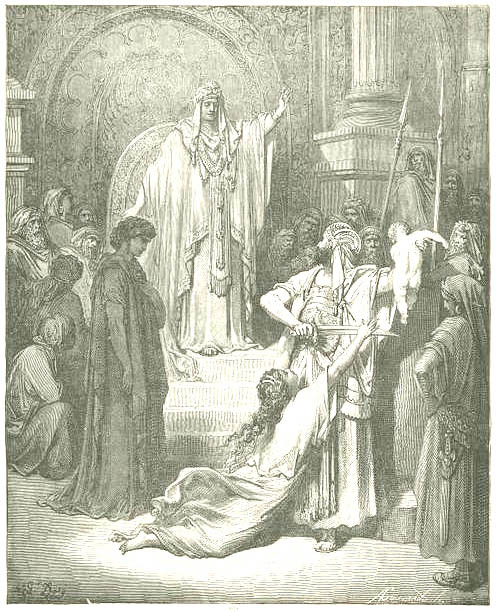
The Judgement of Solomon by Gustav Doré
Cain’s murder of his brother, Abel; the jealous brothers of Joseph who sell him into slavery and then deceive their father Jacob; King Saul in his bitter rivalry with the younger David; King David himself in his plotting against Uriah; Solomon’s problem of the two women who claim the same infant after one of them has overslept her own child; Jezebel the wife of King Ahab in her dispossession and murder of Naboth; those two Babylonian elders who plot against Susanna; Herod the Great’s storied resentment of the infant Jesus; the capitulation of Herod Antipas to the desire of his wife Herodias to see the head of John the Baptist on a platter; Caiaphas the High Priest who sees the elimination of Jesus as a means of avoiding a greater disorder and his own overthrow; Pilate in his sentencing of Jesus to death, despite his obvious misgivings.
Is there not an obvious pattern, a sameness, in these stories of moral failure, and then violence?
Is not the consistent root cause of that failure what is now called status anxiety – fear of loss of the respect of important others – fear of shame?3
If so, what do we call the sin that led them in the end to capitulate to that fear – and to violence?
Does not Jesus’ disregard for his status – his freedom in calling out religious hypocrisy but lack of vindictiveness in accepting ‘blowback’ – cast the problem of his accusers and judges in the sharpest relief? Where he could accept the greatest humiliation they could not even accept the verbal charge of hypocrisy.
If his most singular virtue was indeed his humility – his willingness to tolerate humiliation, what was obviously – by contrast – their vice?
Integrity and Holiness
Is it not obvious that in asking Jesus to endure the Crucifixion the will of the Father was for Jesus to witness to the Kingdom of God of which he had preached unarmed and selflessly – right to the bitter end – and that the rejection of that kingdom by his accusers was the immediate cause of his arrest and trial? Having preached mutual service rather than ambition, and the turning of the other cheek when insulted, how could it have been consistent for Jesus in the end to choose the only alternative to arrest and crucifixion – domination and war?
How could he have chosen that option without matching and mirroring the pride of his enemies?
Is not aggressive violence always a choosing of pride before the kingdom of God? Is that same kingdom not exemplified by all who bear with humiliation without violence? Are there not many such in Ireland today?
And was it not especially to take away all of these particular sins of pride – past, present and future – that Jesus died, in obedience to the Father?
Pride and Violence
Strikingly, although YouCat does list pride among the capital sins it nowhere defines or describes or instances this vice – especially as a danger to young people today. It does not even list pride in its index – while sexual behaviour and the church’s rules for that – including those for birth regulation – feature prominently.

St Anselm of Canterbury
And although YouCat does explore Jesus’s opposition to violence it does not link this to the explanation of the cross. Jesus is obedient to the Father but nowhere is it stated clearly that the Father’s willing of the Cross was a protest against prideful violence, and not a seeking of it.
And nowhere in YouCat is the psychology of violence explored – despite the fact that the Bible is probably the greatest of all literary sources on the subject.
The most likely explanation for these failures is the Catholic theological inheritance of the Middle Ages. St Anselm of Canterbury could not ask himself in the 1090s if the Christian violence sanctioned first by Constantine in 312 – for example the violence of the first Crusade (1096-99) – might be tainted by pride, so instead he interpreted the Cross not as a protest against violence but primarily as the logical repayment of a debt owed to the Father by sinful humanity4. This unhelpful emphasis has trickled down the centuries – to the 1994 adult Catechism of the Catholic Church and to its 2011 offspring, YouCat.
The result is a resource that risks attributing the human weakness of status anxiety – and even the vice of pride – to God himself – when redemption obviously has to do with the opposite understanding – that God is, above all, both love and humility – and that he offers, through Jesus, freedom from all fear, including fear of shame.
‘Satan’?
The non-appearance of the name Satan in YouCat can possibly be explained by the need to emphasise the totality of the victory of the Cross, but given the certainty of questions about Satan from young people, this is a mistake. There is an often overlooked advantage in attributing all human fault in the beginning to some source other than ourselves, and a particular advantage in attributing our status anxiety – our chronic tendency to doubt our own value as we are – to an external source, as do Genesis and the Gospels. That value becomes clear if we ask ourselves how we might counsel a young person who has been overwhelmed by an impulse towards violence, as in that TV drama Adolescence.
Is not murderous pride indeed a deeply mysterious and dark entity, a ‘force’ that can ‘get into’ us – in the most ‘tragic circumstances’? Do we truly know what we are doing then? Do we not all need to realise that this too was the Evil that was overcome in Gethsemane and on the Cross, for the forgiveness of even the worst of sins?
That the word ‘Satan’ means ‘the accuser’ – thereby naming the historical pattern of false accusation that can lead to ostracisation and lynching – is surely important for young people to know also, in a pervasive climate of online aggression and the scapegoating of immigrants.
And do we not all need to be fully conscious of what we are doing at Easter, when we renounce Satan, the author of all sinful pride?
‘Do Not Covet’?
Not for nothing does Genesis point to the ‘serpent’ as the author of all human dissatisfaction. “You are not enough as you are!” – is not this the insistent message we all mysteriously hear, in every encounter with someone who seems to have more. This too is something that young people need to understand. Our tendency towards comparison, towards feeling ashamed of what we seem to lack, and towards envy of others – especially for whatever makes those others more popular – explains the power and prestige of the 21st century ‘influencer’ – and all world conflict as well.
 No one has explained the danger of this human frailty better than René Girard5. If we must have whatever our envied neighbour has, what will we do if we cannot have that without violence?
To reflect on the danger of one’s own envy is to be ready to understand also why Jesus was envied by his enemies, and why he was accused. Themselves already socially eminent, those men felt keenly a lack of the supreme gifts of spiritual insight, leadership and healing they recognised in him. They felt most keenly of all his razor-sharp identification of their ‘mask-wearing’ – the pretences that too often go with mere religious performance. This was the birthplace of their conspiracy to kill him, rejecting the Kingdom they could otherwise have freely entered.
It is another peculiarity of YouCat that while it does list the warning against coveting among the ten commandments it nowhere explains the term. Don’t young people need to realise how this weakness, which we all share, is so helpful in explaining the chaos that surrounds us?
Covetousness, envy and pride – and not the will of God the Father – were together the wellspring of the violence of the Crucifixion, and lie at the root of all aggression today.
Revision
YouCat needs revision. In striving to emphasise Jesus’ obedient taking away of sin it backgrounds what led to his arrest, condemnation and execution – the rejection of the Kingdom of God by those in power. This is misguided, especially in a work intended for the young.
- YouCat needs to name and highlight the particular sins that motivated the enemies of Jesus – the sins that above all need to be taken away.
- In explaining the crucifixion it needs to summarise what is now well known, especially following the insights of scholars such as René Girard and James Gilligan, about the psychological and social origins of violence.
- As it stands, YouCat’s multiple references to sin, without specificity, reinforce the perception that Catholicism is still fixated on ‘sins of the flesh’, and its index – given especially what isn’t anywhere there – reinforces that view.
- When it comes to ‘God’s will’ YouCat needs to say more clearly that God willed the salvific outcome of the crucifixion – the gift of Jesus’ obedience – but not the sin, the violent motives, that led to the crucifixion. The Cross reveals the human cycle of: covetousness > envy > pride > violence – but not any will of God for violence.
- The absence of any mention of ‘Satan’ needs to be reconsidered, to justify the liturgical Easter references, to emphasise the subtlety of temptation and to name the mystery of evil.
- Especially regrettable therefore is the marginalisation of Jesus’s central teaching on the Kingdom of God – the peaceful kingdom that can never emerge out of violence. How else can ‘God’s will’ – and the Lord’s prayer – be properly explained?
Do not all young people these times need to know that when they ‘bite their tongues’ – instead of answering insult with insult, online or elsewhere – they too are building the kingdom of the Father – by taking up that cross?
Was it not to ensure the coming of that Kingdom that Jesus died, in obedience to the Father, to ensure that evil will not win – because covetousness, envy and pride – and violence and death and shame – now have no final dominion over anyone?
Sean O’Conaill
March 2025
NOTES
- Archbishop Eamon Martin speaking at the conclusion of the Pre-Synodal Assembly of the Irish Synodal Pathway in Kilkenny on 18 Oct 2025. https://synod.ie/video-presentations-from-kilkenny-assembly-available-now/
- James Gilligan, Violence: Our Deadly Epidemic and Its Causes. Putnam Publishing Group 1996
- Alain de Botton, Status Anxiety, Penguin, 2004
- St Anselm of Canterbury, Cur Deus Homo, 1098
- Wolfgang Palaver, René Girard’s Mimetic Theory, Michigan State University Press 2013
0 Comments